I Ruined a Batch of Caramel Before I Learned This Kitchen Lesson
A 2-in-1 digital kitchen scale and thermometer solves the specific problem of needing weight and temperature at the same time.
 By Ahamed Khan
In this guide9
- 01The real problem: weight and temperature rarely get measured together
- 02What it actually does well
- 03When this isn’t the right tool
- 04Common myths about kitchen scale-thermometers
- 05What to expect over months of use
- 06The bottom line
- 07Submit Your Story
- 08How This Article Was Created
- 09Frequently Asked Questions
I ruined a batch of caramel the first time I tried making it, not because I measured the sugar wrong, but because I had no idea how hot the pan actually was until it had already gone past the point of no return. I was guessing by colour and smell, which works for an experienced cook and doesn’t work at all for someone making caramel for the second time in their life. What I actually needed was a thermometer sitting right next to my scale, and eventually I found a tool that’s both at once.
A 2-in-1 digital kitchen scale and thermometer solves a narrower problem than it sounds like: it’s for the moments when you need to know a weight and a temperature in the same few seconds, without digging through a drawer for a second tool. Here’s where that actually matters.

The real problem: weight and temperature rarely get measured together
Most kitchens have a scale in one drawer and a thermometer in another, if they have a thermometer at all. That’s fine for recipes that only need one or the other. It falls apart for anything where both matter in sequence — tempering chocolate, making candy, checking if a sauce has reduced to the right consistency, or portioning ingredients that need to be a specific temperature when added.
The gap shows up as guesswork. You weigh something, then eyeball the temperature, or you check the temperature and estimate the quantity, and the result is a recipe that’s close but not quite right. It’s not a dramatic failure every time, but it’s the difference between a dish that works and one that’s “pretty good, I guess.”

What it actually does well
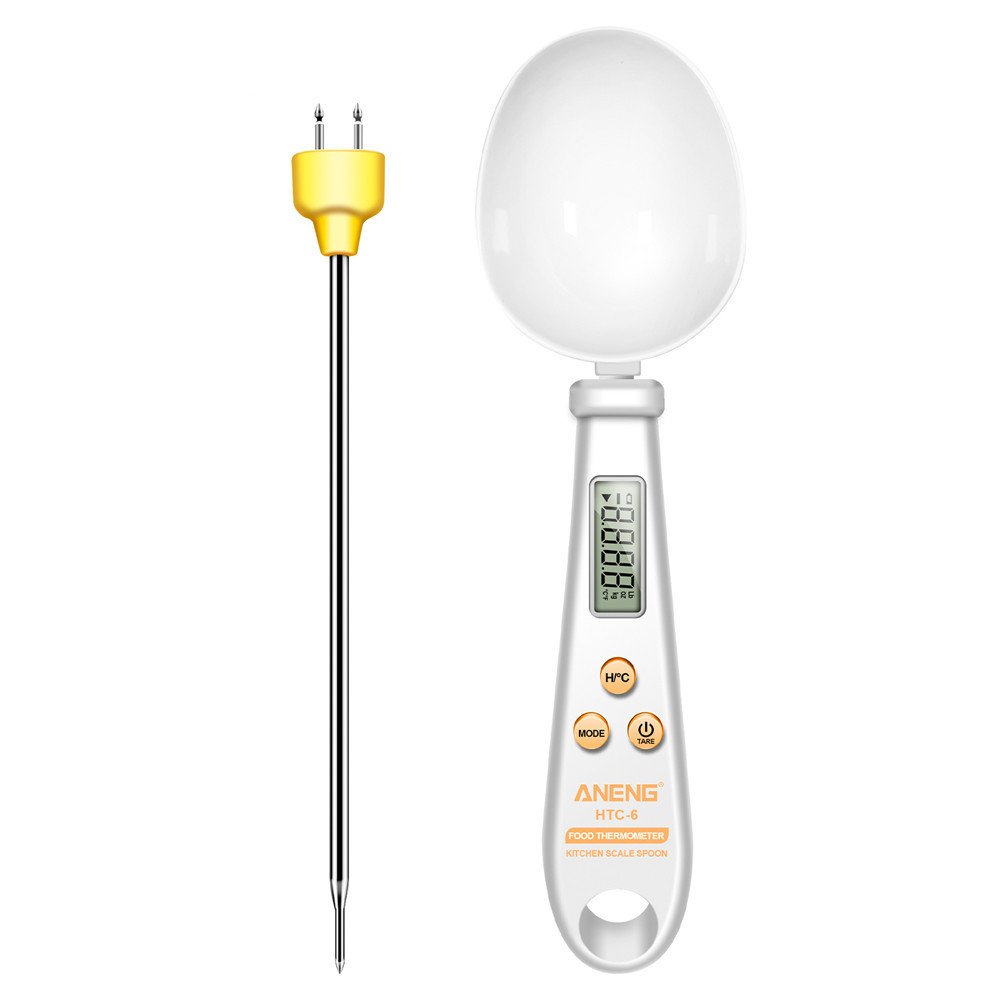
This is a precision tool for small quantities — it reads to the gram and gives a temperature readout on the same digital display, in a spoon-shaped body that doubles as a measuring scoop. It’s built for the moments where you’re adding a small, specific amount of something at a specific temperature, not for weighing a five-kilogram turkey.
Common mistakes with 2-in-1 kitchen tools
- Expecting lab-grade thermometer accuracy from a budget tool — it’s good enough for cooking decisions, not scientific research
- Not zeroing the scale before each new ingredient, which throws off a multi-ingredient recipe fast
- Submerging the whole unit in liquid to get a reading, which risks the electronics rather than just dipping the probe end
- Using it for large-batch cooking where a bigger dedicated scale would actually be faster
When this isn’t the right tool
If you cook mostly by volume — cups and spoons, no precision weighing — this solves a problem you don’t have. And if you regularly work with large batches, a bigger kitchen scale with a wide platform will be faster and more comfortable than a spoon-style scale built for small quantities. This tool earns its keep specifically in precision, small-batch situations: baking, candy-making, coffee, cocktails, or any recipe that specifies grams and degrees rather than cups and “medium heat” — see our kitchen utensils picks for more precision tools in the same spirit.
Common myths about kitchen scale-thermometers
“A scale and a thermometer together must be less accurate than two separate tools.” Not inherently — the two functions use separate sensors even though they share one display. Combining them is a convenience decision, not an accuracy compromise.
“You only need this for professional baking.” Most of the value shows up in ordinary home cooking — getting a sauce to the right temperature before adding dairy, or portioning coffee grounds precisely for a stronger or weaker brew. You don’t need to be running a bakery to benefit from accurate small measurements.
“Digital kitchen tools are fragile and don’t last.” The electronics are protected inside the handle, and the parts that actually touch food or heat are built for that contact. Normal kitchen use — wiping down, occasional water contact near the probe — is what it’s designed for. Our kitchen gadget buying guide covers the same durability questions for other countertop tools, if you’re building out a precision-cooking setup.
What to expect over months of use
The button cell battery is the part most likely to need attention eventually — expect it to last a long time under normal home-cooking frequency, since the display only draws power while active. Keep it away from the dishwasher and wipe it down by hand, and the display and buttons should hold up well past the battery’s first replacement.
The bottom line
This isn’t a tool everyone needs, but if you’ve ever guessed at a temperature while also trying to get a weight right, it removes that specific friction. A 2-in-1 scale and thermometer costs about the same as one good coffee order, and it quietly fixes the “which tool do I reach for first” problem every time a recipe needs both numbers at once.

2-in-1 Digital Kitchen Scale & Thermometer
A digital kitchen scale that also reads temperature on the same display, in a compact spoon-shaped design. Black or white.
$22.99
View productSubmit Your Story
Have a kitchen disaster that could have been avoided with better measuring, or a precision-cooking trick worth sharing? I’d love to hear it — share your story through our contact page and we may feature it in a future article.
How This Article Was Created
This article was written from firsthand kitchen experience with precision cooking and candy-making, combined with the practical features of the scale we stock. No statistics were invented for this piece, and nothing here is professional culinary advice beyond ordinary home-cooking common sense.
Frequently Asked Questions
Why does caramel burn or crystallise?
Caramel goes from perfect to burnt in seconds because sugar cooks fast at high heat. Watching the temperature and color closely is the key.
Do I need a thermometer to make caramel?
A candy or instant-read thermometer removes the guesswork, since caramel stages happen at precise temperatures. It is the easiest way to avoid mistakes.
What thermometer is best for candy and caramel?
A clip-on candy thermometer or a fast digital probe that reads high temperatures works best. Look for a clear scale and a stable clip.