I used to lose about five minutes every morning to the same small battle: digging through a drawer that had turned into a single tangled mound of socks, underwear and things that had migrated in from other drawers. I’d pull out a sock, fail to find its match, pull out three more, and leave the whole drawer looking like it had been burgled. Multiply that by every morning and it’s a genuinely annoying amount of wasted time and low-level irritation.
The fix wasn’t folding everything perfectly or buying a new dresser. It was dividing the drawer. Once every item had its own small compartment, the mess simply had nowhere to form. This is a guide to doing that properly — why drawers descend into chaos, how compartment organisers fix it, and the mistakes that stop people from getting the tidy drawer they wanted.
Why drawers turn into a mound
A drawer is just an open box, and an open box invites piling. You drop clean laundry on top, take items from the top, and over a week or two everything migrates into one shifting heap. Socks unpair themselves. Underwear ends up under a belt that ended up under a scarf. The drawer isn’t small — you just can’t use the space, because there’s no structure telling each thing where to live.
It’s worse in an apartment, where drawers are often shallow and shared between more categories than they were meant for. When one drawer has to hold socks, underwear, and the odd accessory, the pile forms twice as fast. Dividing that single space into compartments is what turns it from a heap back into storage.
How a compartment organiser fixes it
The idea is simple to the point of feeling obvious once you’ve used one. A grid-style drawer organiser drops into the drawer and splits it into a set of small, equal compartments — in this case 24 of them. Each pair of socks, each set of underwear, each small folded item gets its own square. You can see everything at a glance, nothing slides into anything else, and putting laundry away becomes a matter of dropping items into their slots rather than balancing them on a pile.
Because the whole thing is foldable, it collapses flat when it’s empty, so you can move it between drawers, take it out to clean the drawer, or pack it when you travel. There’s nothing to install — it simply sits inside the drawer and does its job.
What goes in the grids
- Socks — one pair per square, so matching pairs stops being a hunt.
- Underwear — folded or rolled, each set visible in its own compartment.
- Bras — kept in shape rather than crushed flat at the bottom of a pile.
- Small accessories — ties, belts, hair clips, watches, the bits that never had a home.
Fold so you can see everything
Compartments do most of the work, but they work best paired with one habit: fold or roll items so they stand upright in their square, rather than stacking them flat. When things stand up, you see every item from above like files in a drawer, and you pull one out without disturbing the rest. Stacked flat, you’re back to lifting the top to find the bottom. This is the single change that makes a divided drawer stay tidy instead of slowly re-piling.
It sounds fussy, but it takes seconds once it’s a habit, and it’s the difference between an organiser that stays neat for months and one that’s a mess again by the weekend.
The mistakes people make
Trying to organise bulky clothes in small grids
A compartment organiser is built for small items. Jumpers, jeans and bath towels won’t fit a grid and shouldn’t go in one — they belong folded in a larger drawer or on a shelf. Match the tool to the contents: small things in compartments, bulky things elsewhere. Forcing a thick jumper into a sock grid just breaks the system.
Overstuffing each compartment
The point of a grid is one item, or one pair, per square. Cram three pairs of socks into one compartment and you’re back to a mini pile inside a box. If you have more than the grids can hold, that’s a signal to declutter — not to overfill. Which brings us to the next mistake.
Skipping the declutter
Organising is not the same as decluttering, and an organiser can’t fix having too much. Before you divide the drawer, pull everything out and be honest: the socks with holes, the underwear you never wear, the odd single sock waiting years for its partner. Keep what you use, bin or donate the rest, and only then divide what’s left. A drawer organiser holding only things you actually wear is transformative. One stuffed with things you don’t is just neater clutter.
Putting it off because it feels like a big job
It isn’t. Dividing one drawer with an organiser is a fifteen-minute job, most of which is the decluttering. People imagine a whole-bedroom overhaul and never start. Do one drawer — the sock and underwear drawer you open every single day — and the daily payoff is immediate enough that you’ll want to do the next one.
It’s not just for the bedroom
Once you’ve used a compartment organiser in one drawer, you start seeing every messy drawer in the house differently. The same grid that tames socks works just as well in a bathroom drawer, sorting cotton pads, hair ties, small bottles and grooming bits that otherwise roll around loose. In a desk drawer it keeps cables, chargers, pens and sticky notes from becoming the usual tangle. In a child’s dresser it turns tiny clothes — which are the worst offenders for vanishing into a pile — into something you can actually see and grab in a hurry.
Because a foldable organiser lifts out and folds flat, it’s easy to move it to wherever the mess is worst this month. Buy it for the sock drawer, and don’t be surprised when it migrates to the bathroom a few weeks later because someone in the house decided that drawer needed it more.
Keeping it tidy over time
The honest truth about any organising system is that it drifts if you let it. The compartments make drifting much harder, but a couple of small habits keep a divided drawer genuinely tidy for the long run. Put laundry away into its slots rather than dumping it on top to “sort later” — later never comes. Every month or so, take thirty seconds to re-pair any socks that have wandered and pull out anything that’s crept in from elsewhere. And when the organiser itself gets dusty, lift it out, wipe the drawer and the organiser, and drop it back in.
None of this is real work. The system does the heavy lifting; you’re just not fighting it. A well-divided drawer that you top up sensibly stays tidy far longer than a heap ever could, which is the whole point — you set it up once and then stop thinking about it.
If you live in an apartment where every drawer has to work hard, or you just want to reclaim the five minutes a tangled drawer steals each morning, a foldable grid organiser is about the cheapest, fastest home upgrade there is. It won’t reorganise your life. It’ll just make one drawer, the one you use most, quietly work the way it always should have.
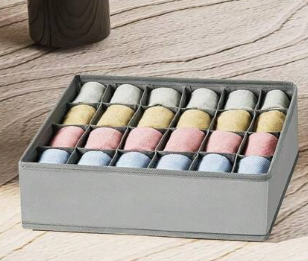
24-Grid Foldable Drawer Organizer
Splits one drawer into 24 compartments for socks, underwear, bras and accessories. Foldable, drops straight in, no fitting. secure checkout across the GCC.
Price range: $7.99 through $12.99
Submit Your Story
Have a drawer-organising method that finally stuck, or a decluttering trick worth sharing? I’d like to hear it — what you sort, how you keep it that way, and any mistake you made early on so others can skip it. Share your story through our contact page and we may feature it in a future article.
How This Article Was Created
This article was written from personal experience organising small home drawers and from the practical features of the drawer organiser we stock. No statistics were invented for this piece, and it makes no claims beyond the everyday, verifiable point that dividing a drawer into compartments keeps small items easier to find. Product details such as the 24-grid layout and folded dimensions describe the item sold on this store.