Countertop Dishwasher Buying Guide: Size, Cycles and Setup
A practical guide to choosing a countertop dishwasher: faucet vs tank fill, place-setting capacity, cycles, and what to check before you buy.
 By Ahamed Khan
In this guide7
A countertop dishwasher is one of the simplest ways to stop washing dishes by hand without remodeling your kitchen or signing off on an expensive built-in unit. For renters, small households, dorms, and anyone whose kitchen never came with a full-size machine, this compact appliance sits on the counter, connects to your faucet or fills from its own water tank, and runs a complete wash cycle in about an hour. This guide breaks down how a countertop dishwasher actually works, the capacity to expect, and the features worth paying for. It is written first for US shoppers, with practical notes for Gulf (GCC) and broader international buyers along the way.
Why a Countertop Dishwasher Makes Sense
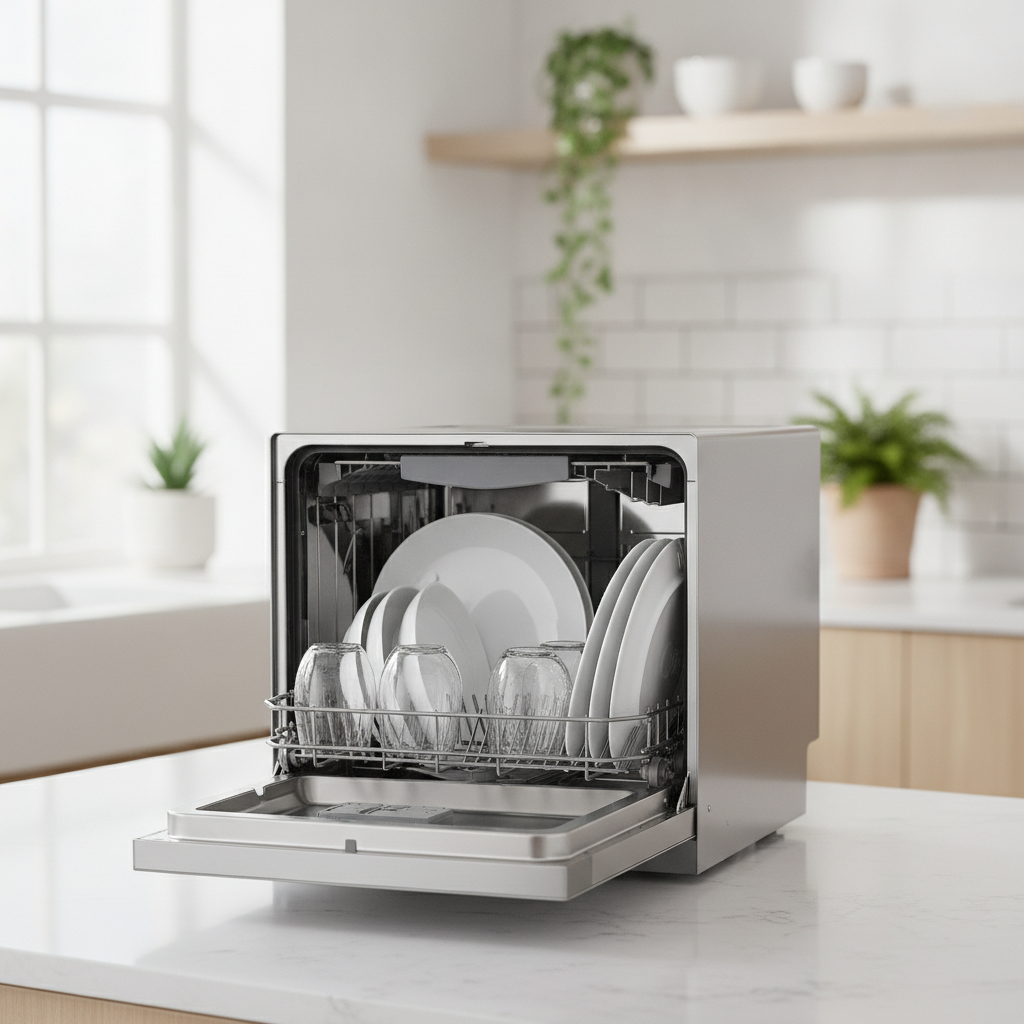
The appeal is space. A typical countertop model is roughly the size of a microwave, so it fits in apartments, condos, RVs, and offices where a 24-inch built-in dishwasher would never go. In the US, that makes it a favorite for small-kitchen rentals and first apartments where tearing out cabinets is off the table. In Gulf households, where kitchens are often fitted out separately after move-in and tenants prefer appliances they can take with them, a portable unit is easy to justify. For international and EU buyers in older flats with limited plumbing, it offers a full wash without a permanent install. You still get sanitizing hot-water cycles and far better water efficiency than running the tap, typically using only a few liters per load compared with the gallons a hand-wash session wastes.
Capacity: How Much Can It Actually Wash?
Capacity is measured in place settings, where one setting is roughly a dinner plate, a side plate, a bowl, a glass, a mug, and a set of utensils. Most countertop dishwashers hold between two and six place settings. A two-to-four setting model suits one or two people and handles a daily dinner cleanup with room to spare. A five-or-six setting unit is better for a small family or anyone who cooks a lot and wants to run fewer loads. Be realistic about what you wash: tall glasses, large dinner plates, and pots eat into the rated capacity quickly, and a machine that claims six settings may only fit four once you add oversized items. If you regularly cook for guests, size up rather than down. Measuring your largest plate against the rack height before buying saves a lot of frustration later.
Faucet Hookup vs. Built-In Water Tank
This is the single most important decision, because it determines where the machine can live. Faucet-connected models attach to your kitchen tap with an adapter and draw water automatically, which means unlimited loads but a permanent spot next to the sink. Tank-fill models have an internal reservoir you fill by hand or with a pitcher, so they can sit anywhere there is a power outlet and a nearby drain or bucket. Many newer units offer both, letting you connect the hose when convenient and switch to the tank when not. For US kitchens with standard threaded faucets, the included adapter usually fits without fuss, though pull-down sprayer faucets sometimes need an extra part. Gulf and international buyers should confirm the adapter matches local faucet threads and that household water pressure is high enough for the inlet valve, as very low pressure can stall a fill. Tank models sidestep the threading question entirely, which is why they travel so well.
Cycles, Features and Running Costs
Beyond size and water source, the feature set is what separates a machine you tolerate from one you rely on. The options worth looking for:
- Cycle range: a good unit offers normal, heavy, eco, speed, and rinse cycles, plus a glass or fruit-wash mode on some models.
- Sanitizing heat: a high-temperature rinse that reduces bacteria matters for baby bottles and cutting boards.
- Drying method: heated drying finishes dishes faster, while air-dry and fan-dry options use less electricity.
- Delay start and controls: a timer lets you run loads overnight, and a clear digital panel beats cryptic button combinations.
- Noise level: look for a rating around 50 decibels or lower if the kitchen opens onto a living space.
On running costs, countertop dishwashers are modest. They draw more power than a laptop but far less than an oven, and the heated water is the biggest energy user, so eco and cold-fill cycles trim the bill. US buyers can look for an ENERGY STAR label; Gulf and EU shoppers will find similar efficiency ratings printed on the box. If you live somewhere with hard water, which covers much of the Gulf and large parts of the US Southwest, add rinse aid and the occasional descaling cycle to keep spray arms clear and glasses spot-free.
What to Check Before You Buy
- Counter clearance: measure width, depth, and the height needed to open the top and load the racks.
- Voltage and plug: US models run on 120V; Gulf and EU buyers need a 220-240V unit and the correct plug type, so confirm the local version rather than importing a US spec.
- Drainage: faucet models drain back into the sink, while tank models need a drain hose routed to a basin or bucket.
- Included accessories: check that a faucet adapter, inlet hose, and cutlery basket come in the box.
- Warranty and support: a one-to-two year warranty with locally available service is worth more than a slightly cheaper unit with none.
It helps to think of a countertop dishwasher the way you would any compact appliance: the right fit for your space and habits beats the longest spec sheet. If you are kitting out a small kitchen, it pairs naturally with other space-savers. Browse our full buying guides for related picks, and if you want another counter-friendly workhorse, our countertop ice maker guide covers the same small-footprint thinking. You can also see the latest compact appliances in the AKNB Global shop.
Frequently Asked Questions
How many place settings does a countertop dishwasher hold?
Most fit 2 to 6 place settings, enough for one or two people. Large plates and pots often will not fit, so check the stated interior height.
Do countertop dishwashers need plumbing?
No. Most connect to a faucet with an adapter or fill from a built-in tank, which makes them ideal for apartments and rentals.
Are countertop dishwashers worth it for a small household?
Yes. They use less water and energy than hand-washing, free up time, and suit kitchens with no room or hookups for a full-size unit.
Looking for countertop dishwasher options with fast shipping? See current listings on Amazon. As an Amazon Associate, AKNB Global earns from qualifying purchases.
The Bottom Line
A countertop dishwasher delivers most of the convenience of a built-in machine in a fraction of the space, which is exactly why it suits renters, small families, and anyone short on cabinetry. Decide between faucet and tank fill first, match the place-setting capacity to how you really cook, and confirm the voltage and warranty for your region before you check out. Get those three right and you will wonder how you managed at the sink for so long. Compare the current models, pick the size that fits your counter, and let the machine handle the rinse while you get on with your day.