Cable Chaos in Every Bag? Here’s How I Finally Fixed It
A zip-up cable organizer with real compartments stops chargers, cables, and small electronics from tangling in a bag or drawer.
 By Ahamed Khan
In this guide9
- 01The real problem: cables don’t stay where you put them
- 02What actually works: separation, not just storage
- 03When this isn’t the right fix
- 04Common myths about cable organizers
- 05What to expect over months of use
- 06The bottom line
- 07Submit Your Story
- 08How This Article Was Created
- 09Frequently Asked Questions
My backpack used to be a crime scene. Three different charging cables tangled into one knot, a power bank rolling around loose, a mouse with its cord wrapped around nothing in particular, and at least one cable I couldn’t identify by the time I actually needed it. I’d dig through all of it standing in an airport lounge or a coffee shop, usually running late, usually annoyed. The gear wasn’t the problem. The way I was carrying it was.
The fix took me longer to accept than it should have, because it’s almost too simple: a zip-up cable organizer case with actual compartments, where cables go in and don’t come back out in a tangle. Here’s what changed once I started using one, and what to look for if you’re dealing with the same mess.

The real problem: cables don’t stay where you put them
A loose cable in a bag pocket doesn’t stay coiled. It unwinds, wraps around whatever else is nearby, and finds the one gap in your bag where it can hide. Multiply that by three or four cables, a couple of adapters, and a power bank, and you’ve got a small knot of frustration waiting at the bottom of your bag every time you reach in.
It’s not just an annoyance. Loose cables fray faster when they’re constantly yanked out of a tangle, connectors bend at bad angles under that stress, and small items like SD cards or earbuds genuinely do get lost in the gap between a laptop and a bag’s lining. The disorganisation has a real cost — it just shows up slowly, one frayed cable and one missing accessory at a time.

What actually works: separation, not just storage
The mistake I made for years was buying “organizers” that were really just one slightly smaller bag inside a bigger bag. That doesn’t solve anything — it just moves the tangle one layer in. What actually works is a case with elastic loops and mesh pockets that physically separate each item, so a charging cable can’t wrap around your mouse cord even if it wanted to.
The habit that makes it work is boring but important: put the cable back in its loop right after you unplug it, not “later.” Later is how bags become crime scenes again. It takes maybe five extra seconds, and it’s the entire difference between a case that works and one that quietly turns into another junk drawer.
Common mistakes people make with cable organizers
- Buying one that’s too small for the actual cable count carried, so it gets overstuffed and tangles anyway
- Coiling cables too tightly, which stresses the wire near the connector over time
- Treating it as a drawer at home instead of a travel case, so it never actually leaves the house
- Not separating charging bricks from cables, which adds bulk and weight in the wrong compartment
When this isn’t the right fix
If you only carry a single phone charger and nothing else, an organizer case is overkill — a simple pouch solves that in five seconds. This kind of case earns its place once you’re carrying three or more cables, a power bank, and small accessories together, which is when tangling actually becomes a daily problem rather than an occasional one.
It’s also not meant to protect fragile electronics from impact. It’s a soft fabric case for organisation, not a hard shell. If you’re packing delicate gear for a flight, that’s a separate problem with a separate solution — our home office setup guide covers some of that ground if a permanent desk fix is more what you need than a travel case.
Common myths about cable organizers
“Any small bag works just as well.” Not really — the difference is in the internal structure. A bag with no loops or divided pockets just becomes a smaller version of the same tangle. The loops and separate compartments are the actual feature, not the zip or the fabric.
“They’re only for frequent travellers.” Desk cable chaos is just as real as bag cable chaos. A lot of people keep one of these in a desk drawer purely to stop charging cables, old adapters, and spare cords turning into a loose pile every time the drawer opens — see our desk tech picks for more of that kind of everyday fix.
“More compartments always means better.” Past a certain point, more tiny compartments just means more decisions about where each item goes, which slows you down. A handful of well-sized loops plus one flexible mesh pocket covers almost everyone’s actual cable collection.
What to expect over months of use
A well-made fabric organizer case holds up fine to daily zipping and unzipping — the zip pull and the stitching around the loops are the parts that see the most wear. Expect the fabric to soften slightly with use, which is normal, and expect the elastic in the loops to stay snug for a long time if you’re not overstuffing it past its intended capacity.
The real test isn’t the case itself, it’s whether the habit sticks. Six months in, if cables are still going back into their loops instead of loose in the bottom of a bag, it’s doing its job.
The bottom line
This isn’t an exciting purchase. It won’t make your laptop faster or your commute shorter. What it does is remove one small, recurring annoyance from your day — the minute or two of digging and untangling that happens every single time you need a cable. Over a year, that adds up to a lot of minutes, and a cable organizer case that costs less than a few coffee runs is a cheap way to get them back.

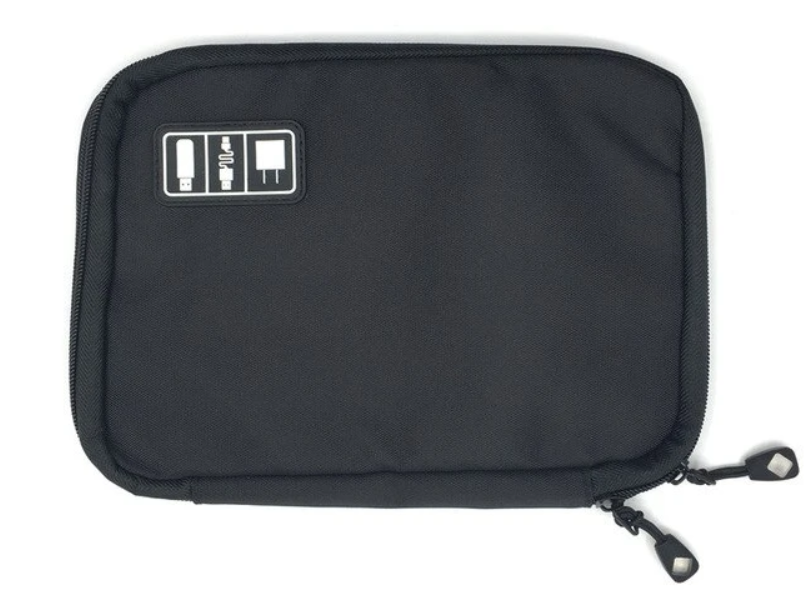
Zip-Up Cable Organizer Case
A zip-closed case with elastic loops and mesh pockets that keeps chargers, cables, and small electronics sorted in one grab-and-go pouch. 15 colours.
$20.99
View productSubmit Your Story
Got a cable-chaos story of your own, or a system that actually works for you? I’d love to hear it — what you carry, how you keep it sorted, and any trick you’ve picked up along the way. Share your story through our contact page and we may feature it in a future article.
How This Article Was Created
This article was written from firsthand experience dealing with tangled cables while traveling and working from a desk, combined with the practical features of the organizer case we stock. No statistics were invented for this piece, and nothing here is technical or safety advice beyond ordinary common sense about handling cables and electronics.
Frequently Asked Questions
How do I stop cables tangling in my bag?
A cable organiser with loops and pockets keeps chargers, cords and adapters separate so they do not knot, and you can see what you have at a glance.
What should a cable organiser hold?
Look for elastic loops for cables, mesh or zip pockets for plugs and power banks, and a slot for earbuds, sized to your everyday carry.
Are hard or soft cable cases better?
Hard cases protect fragile items and hold shape, while soft rolls are lighter and flex into tight bags. Choose by what you carry and your space.